Columbia Law School

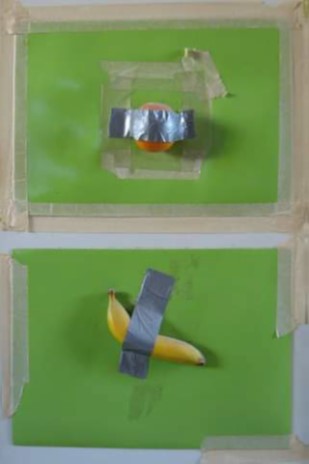
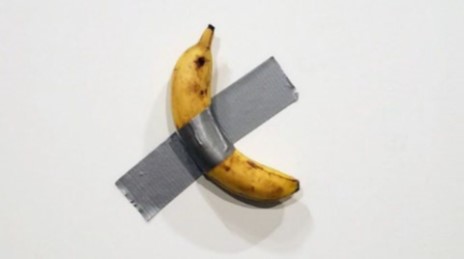
California artist Joe Morford sued Italian artist Maurizio Cattelan for copyright infringement, alleging that Cattelan’s artwork Comedian copied Morford’s earlier work Banana and Orange. Both works depict a banana affixed to a flat surface with duct tape. The Southern District of Florida granted summary judgment in favor of Cattelan, concluding that Morford failed to establish access or striking similarity. Morford, proceeding pro se, appealed. The Eleventh Circuit affirmed. The Supreme Court denied Morford’s petition for certiorari.
Joe Morford created Banana and Orange, a mixed-media artwork consisting of a banana and an orange taped to a flat surface with duct tape. Morford displayed the work on his public Facebook page for several years, featured it in a YouTube video, and referenced it on a blog. Maurizio Cattelan later created Comedian, a sculpture consisting of a banana duct-taped to a wall, which gained widespread attention after selling for over $100,000 at Art Basel Miami. Morford alleged that Comedian infringed his copyright in Banana and Orange.
Morford sued Cattelan for copyright infringement in the Southern District of Florida. The district court granted summary judgment for Cattelan, holding that Morford failed to show that Cattelan had a reasonable opportunity to access Banana and Orange and that the works were not strikingly similar. Morford appealed.
The Eleventh Circuit affirmed, focusing on Morford’s failure to establish factual copying. The appellate court reiterated that, absent direct evidence of copying, a plaintiff must show both access and probative similarity. Access requires evidence that the defendant had a “reasonable opportunity” to view the copyrighted work, which cannot be based on speculation or mere online availability. The appellate court held that Morford’s evidence that Banana and Oranges had reached thousands of online viewers through public posting on social media for over 10 years, a YouTube video, and a blog did not establish the required nexus between Banana and Orange and Cattelan even under a widespread dissemination theory because the widespread dissemination standard requires the work at issue to have “considerable success or publicity” beyond simply being available on the internet.
The Eleventh Circuit also rejected Morford’s argument that striking similarity excused the need to prove access. Striking similarity requires similarity “so great it precludes the possibility of coincidence, independent creation or common source,” a demanding standard that considers the uniqueness and complexity of the protected work. Although both artworks use a banana and duct tape, the appellate court emphasized meaningful differences between the works, including that Banana and Orange includes an additional taped orange, while Comedian does not. The Eleventh Circuit, citing Franklin Mint Corp. v. Nat’l Wildlife Art Exchange, Inc. for the proposition that finding infringement requires the works must be similar in their expression, not just their ideas, notes that because the shared elements were conceptually driven, the similarities did not rise to the level of striking similarity. Having found no access and no striking similarity, the appellate court affirmed summary judgment without reaching the district court’s alternative holdings on substantial similarity or the merger doctrine.
The Supreme Court denied Morford’s request for certiorari.